
How Bench Warrants Work in Grant County
Under Oklahoma law, a bench warrant is arrest process ordered by a court. Title 22, sections 454 through 456, lay out one common path. A defendant out on bail skips arraignment. The court then directs the clerk to issue a bench warrant, and bail forfeiture may follow too. Personal attendance can also be compelled this way when the court wants someone brought in. In Grant County, the Court Clerk records the process and the Sheriff may serve it. The paper alone will not tell you the bond, the hearing, or the recall option that applies now. Those instructions come from the issuing court, so ask there.
Grant County Failure-to-Appear Rules
A missed court date rarely adds just one line to a file. The docket may show a failure to appear, a bench warrant ordered, bond forfeiture, a return or jailed entry, a new initial appearance, or a later recall. Order and case type matter. Jury duty, family court, child support, and criminal attendance each carry different notice and hearing rules in Grant County. So the useful question is broader than "is there a bench warrant?" Ask which court issued it. Ask what event caused it. Ask whether the Sheriff holds the process, and what step comes next.
- FTA
- Failure to appear at a required court setting.
- Bench warrant
- Process directed by a judge or court after a required appearance issue.
- Bond forfeiture
- A court action tied to a missed appearance and the existing bond.
- Recall or quash
- A court order ending or withdrawing the process, subject to docket confirmation.
How Grant County Bench Warrants Are Issued
The clerk does not decide anything here. A judge or magistrate directs the process, and the clerk issues it under that direction. Section 456 sets out a felony form addressed to a sheriff, constable, policeman, or marshal, which shows service is not limited to one office. Grant County's Associate District Judge page states that the judge handles criminal and other proceedings and issues search warrants. The official judge page helps with routing to the judicial office. It is not a public bench-warrant list.
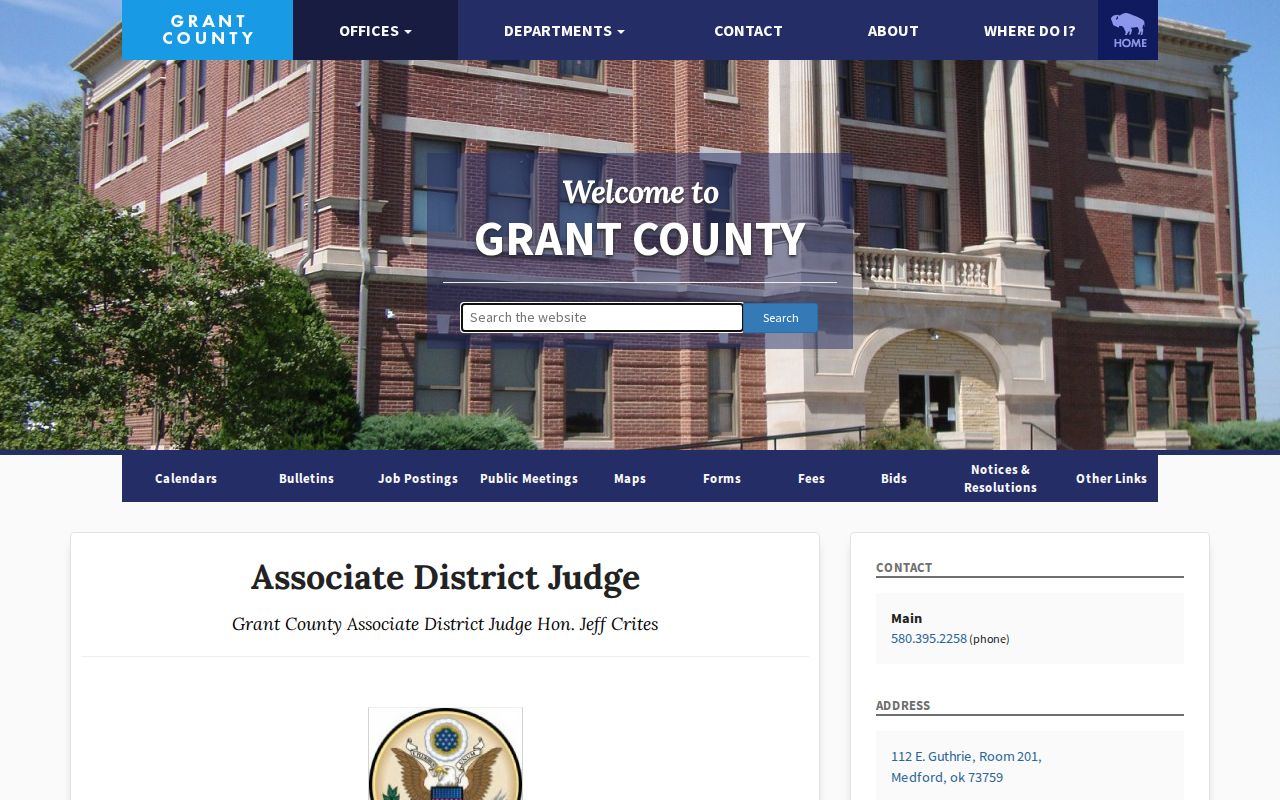
The Grant County courthouse is where the judge's office sits within the county process. It says nothing about any person's case.
How Bench and Arrest Warrants Differ
Both types can put a person in custody. The trigger is what separates them. A bench warrant grows from a court attendance or compliance problem in Grant County. An arrest warrant follows probable-cause process on a sworn complaint or another authorized filing. A bench warrant usually drops after a case has begun, while an arrest warrant can start the arrest process before any first appearance.
| Question | Bench warrant | Arrest warrant |
|---|---|---|
| Usual trigger | Missed required setting or court-directed attendance | Sworn complaint and probable-cause finding |
| Record path | Existing docket and later warrant event | Complaint, warrant form, and case process |
| First local contact | Issuing Court Clerk or municipal court | Issuing court, then Sheriff for service confirmation |
| Resolution question | New setting, recall, quash, bond, or appearance | Current process, counsel, surrender, and bond instruction |
Clearing a Bench Warrant in Grant County
Call the issuing court before you walk in. Ask whether the warrant is active, whether a motion or new setting is required, whether a bond or reinstatement amount is ordered, and where a signed recall or quash order must go. An attorney can shape the response to fit the case. Grant County publishes no walk-in docket, bond schedule, or warrant-recall form. The court's answer is the only one that counts.
Act with care: Do not assume that paying a fine, calling the Sheriff, or seeing an old docket entry has ended a bench warrant.
- Find the case number and issuing court.
- Call the Court Clerk or city court for the docket event and current status.
- Ask the Sheriff whether it has received or served the process.
- Follow the court's bond, appearance, recall, or quash instruction.
- Confirm the next hearing and keep any written order or receipt.
Grant County Courts That Issue Bench Warrants
Grant County District Court handles felony, misdemeanor, and state-law traffic cases. Municipal courts handle city ordinance and municipal-traffic matters. The same words, bench warrant, can point to very different offices.
| Court or office | Typical matter | Contact path |
|---|---|---|
| District Court and Court Clerk | State-law criminal and traffic cases | 112 E. Guthrie Room 202, 580-395-2828 |
| Associate District Judge | Criminal and other proceedings | Room 201, 580-395-2258 |
| Medford Municipal Court | City ordinance and city traffic | City Hall, 580-395-2823 |
| Other city courts | Local ordinance or traffic process | Issuing city police or clerk channel |
The Court Clerk page and Sheriff page explain the county roles.
Medford Bench Warrants Stay Municipal
Medford runs its own municipal bench warrants. The city's official court page says it hears city matters in the Community Room at City Hall, 615 N. Front Street. Sessions start at 3:00 p.m. on the second Tuesday of odd-numbered months. Case, hearing-date, and fine questions go to 580-395-2823. The court posts no online warrant lookup, payment form, bond amount, or recall form. So a Medford warrant check starts with Medford Municipal Court itself. A clean Grant County District Court search on OSCN says nothing about a municipal warrant.
Grant County Sheriff's Service Role
The Grant County Sheriff serves District Court warrants and other lawful process. The office also runs the jail at 219 N. First Street in Medford. Its page lists 580-395-2356 and weekday administrative hours. There is no separate warrant counter or after-hours public surrender process. Ask the issuing court first whether a Sheriff call is even needed. Then ask the Sheriff whether the process is in its service system, and where bond or custody questions belong. The Sheriff cannot replace a judge's recall order.
Grant County Bench Warrant Records
OSCN can show a case prefix, a failure-to-appear event, a bench-warrant order, bond forfeiture, a return, jail, a new setting, or a later recall. Grant County publishes no fixed warrant number format. Read the whole docket sequence, because no single event is the current status.
| Case number | Oklahoma prefix and number tied to the existing District Court case. |
|---|---|
| Trigger | Missed arraignment, hearing, or required attendance. |
| Issuing authority | Judge or court order, with clerk issuance. |
| Serving agency | Sheriff, city police, or another lawful agency named by the process. |
| Later status | Return, served, jailed, recalled, quashed, or a new appearance event. |
Grant County Bench Warrant Limits
The county posts no bond amount, walk-through instruction, amnesty event, or special bench-warrant docket. Juvenile, mental-health, adoption, sealed, and investigation-sensitive records may be closed. The Title 22 statute source explains the state process, but the local court controls the case-specific response. For a wider route through city, court, and Sheriff records, use the Grant County warrant records home.